
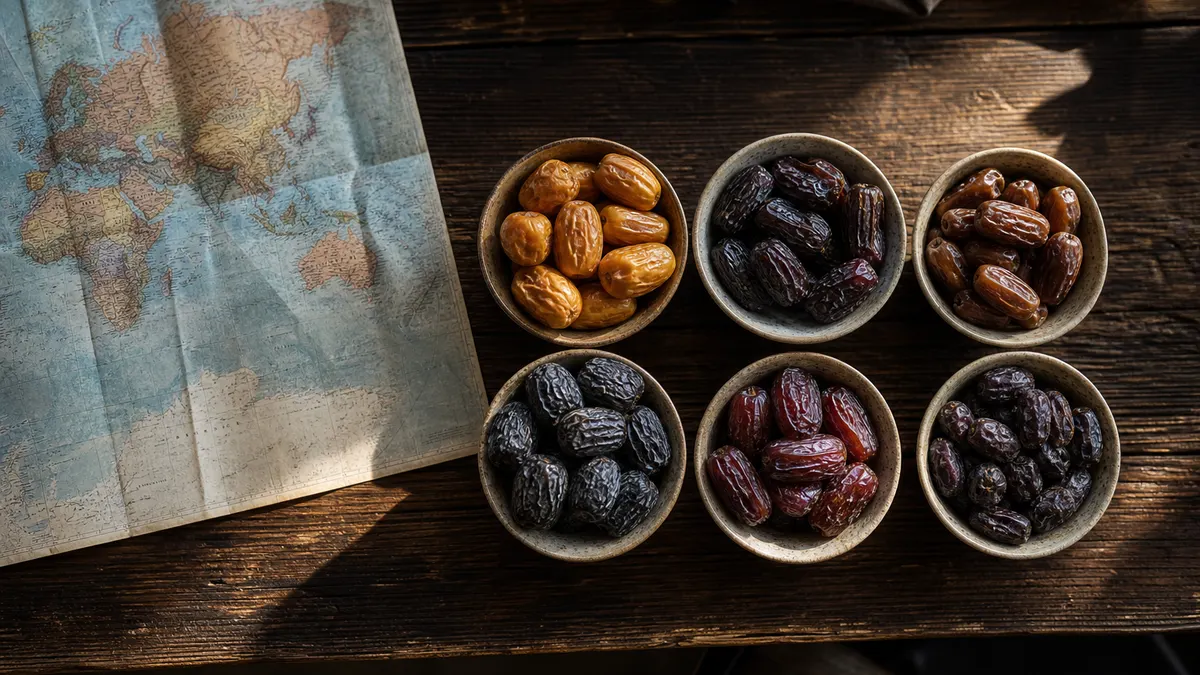
Dates grow well only in dry climates with long, hot summers. The origins supplying Indonesia's market include Saudi Arabia for Ajwa and Sukkari, Iran for Mazafati, Tunisia and Algeria for Deglet Nour, Palestine and the United States for Medjool, and Egypt together with the United Arab Emirates for high-volume varieties.
Why Dates Grow Well in So Few Places
The date palm needs a combination that is not widely available: prolonged heat, dry air while the fruit ripens, and reliable water at the root. That combination is concentrated in the Middle East and North Africa, with a handful of arid regions in the Americas.
The dry-air requirement during ripening is the decisive one, and it explains why dates never became a commercial crop in humid countries such as Indonesia. Rain during ripening damages the harvest. As a result, virtually every date sold in Indonesia is imported, and its quality is determined long before it reaches a warehouse here.
Country by Country
Saudi Arabia.
The best-known origin among Indonesian buyers. From the Madinah region comes Ajwa, a small dark date with the mildest sweetness of all, sought for its standing rather than its sugar. From other regions comes Sukkari, soft and deeply caramel-sweet, one of the fastest-moving varieties in our market.
Iran.
The origin of Mazafati, sold in Indonesia under the market names kurma Bam, kurma anggur, and kurma madu. Its signature is high moisture content, which makes it exceptionally soft. That same quality is why it demands cold storage throughout the chain.
Tunisia and Algeria.
These two North African origins supply Deglet Nour, known in Indonesia simply as kurma Tunisia. It is translucent amber, drier and chewier than most, with a mild sweetness, and it is often sold on the branch, a presentation that stands out on a serving table.
Palestine and the United States.
The two main origins for Medjool, the large, thick-fleshed variety often called the king of dates. For many buyers, Palestinian origin carries an added emotional value, while American origin is known for consistent sizing.
Egypt.
One of the world's largest producers by volume. Its role in the Indonesian market lies mainly in affordable, high-volume varieties that serve everyday consumption and food manufacturing.
United Arab Emirates.
The origin of several varieties in the middle of our catalog, including Khalas, whose flavor sits exactly between mild and rich, along with Lulu, Khenaizi, and Naghal. In our catalog, Safawi, Mabroom, and Sayer are also sourced from the UAE.
The full catalog by origin is available on our products page.
Why the Same Variety Differs Between Origins
Variety sets the fruit's basic character, but not everything about it. Soil, water quality, temperature, and humidity differ by region, and all four influence fruit size, skin color, and moisture. On top of that, harvest and post-harvest handling differ between countries: some regions rely more on hand sorting, others on mechanical grading.
Compare two Medjool shipments from different origins and you will see it. Both are genuine Medjool, yet the fruit size and the depth of color can differ. For a trader this is not a problem as long as you know it and can explain it. It only becomes a problem when photographs from one shipment are used to sell another.
Harvest Seasons and Shipping Windows
Most harvests in the major producing regions fall between the middle and the end of the year, with timing varying by country and by variety. This is the single most overlooked fact in seasonal stock planning.
Harvest windows determine when goods can be shipped, and sea freight plus port clearance takes weeks. That means the dates sold during Ramadan were ordered and shipped months earlier. Delivery schedules are therefore planned backward from the Indonesian selling season, not from Ramadan itself. The full chain is described in our supply chain article.
For Growers, Packers, and Exporters at Origin
We buy directly at origin, and we are continuously evaluating new sources, particularly for varieties where demand in Indonesia is growing faster than our current allocation.
If your company supplies dates at origin, the information that helps us respond quickly is straightforward: the varieties and grades you pack, your packing formats and carton specifications, your harvest calendar, your annual volume, and your experience with halal certification and export documentation for Indonesia. Indonesia requires product registration and halal certification for food entering retail distribution, so suppliers already familiar with those requirements move through evaluation faster.
Write to us at info@smjl.co.id with those details. Our distribution reaches from Sumatra to Papua through warehouses in Jakarta and Surabaya, and our brands serve everything from everyday volume to premium gifting.
What This Means for Distributors and Agents
- Origin is the cheapest trust signal you have. One word on a label or a product page, and the buyer feels they are buying something traceable.
- Origin helps you explain flavor. Buyers asking which variety is softer, or less sweet, can be answered by origin as much as by variety name.
- Diversified sourcing protects your stock. A weak harvest in one country does not halt supply when your supplier buys from many origins. It is a fair question to ask any supplier before you commit.
Frequently Asked Questions
Which countries do dates come from?
Dates thrive only in dry climates with long, hot summers, mainly across the Middle East and North Africa, plus a few arid regions in the Americas. The origins that supply Indonesia's market include Saudi Arabia, Palestine, Tunisia, Egypt, Iran, Algeria, the United Arab Emirates, Iraq, Libya, and the United States.
Which date varieties come from Saudi Arabia?
Saudi Arabia is the origin of Ajwa from the Madinah region, a small dark date with the mildest sweetness of all, and of Sukkari, a soft variety with a deep caramel sweetness. They serve different roles: Ajwa is sought for its standing, Sukkari for being the easiest variety for most palates to love.
Why does the same variety differ between origin countries?
Soil, water quality, and weather differ by region, and all three affect fruit size, skin color, and moisture content. Harvest and post-harvest handling also differ between countries. That is why Medjool from two origins can look and taste slightly different even though the variety is identical.
When is the date harvest season?
Most harvests in the major producing regions fall between the middle and the end of the year, with timing varying by country and by variety. Harvest windows determine when goods can ship, which is why delivery schedules to Indonesia are planned backward from the selling season rather than from Ramadan itself.
Are you open to new suppliers at origin?
Yes. We work directly with growers, packers, and exporters in the producing countries. If your company supplies dates at origin and can meet Indonesian import and halal requirements, write to us with your varieties, grades, packing formats, and harvest calendar.